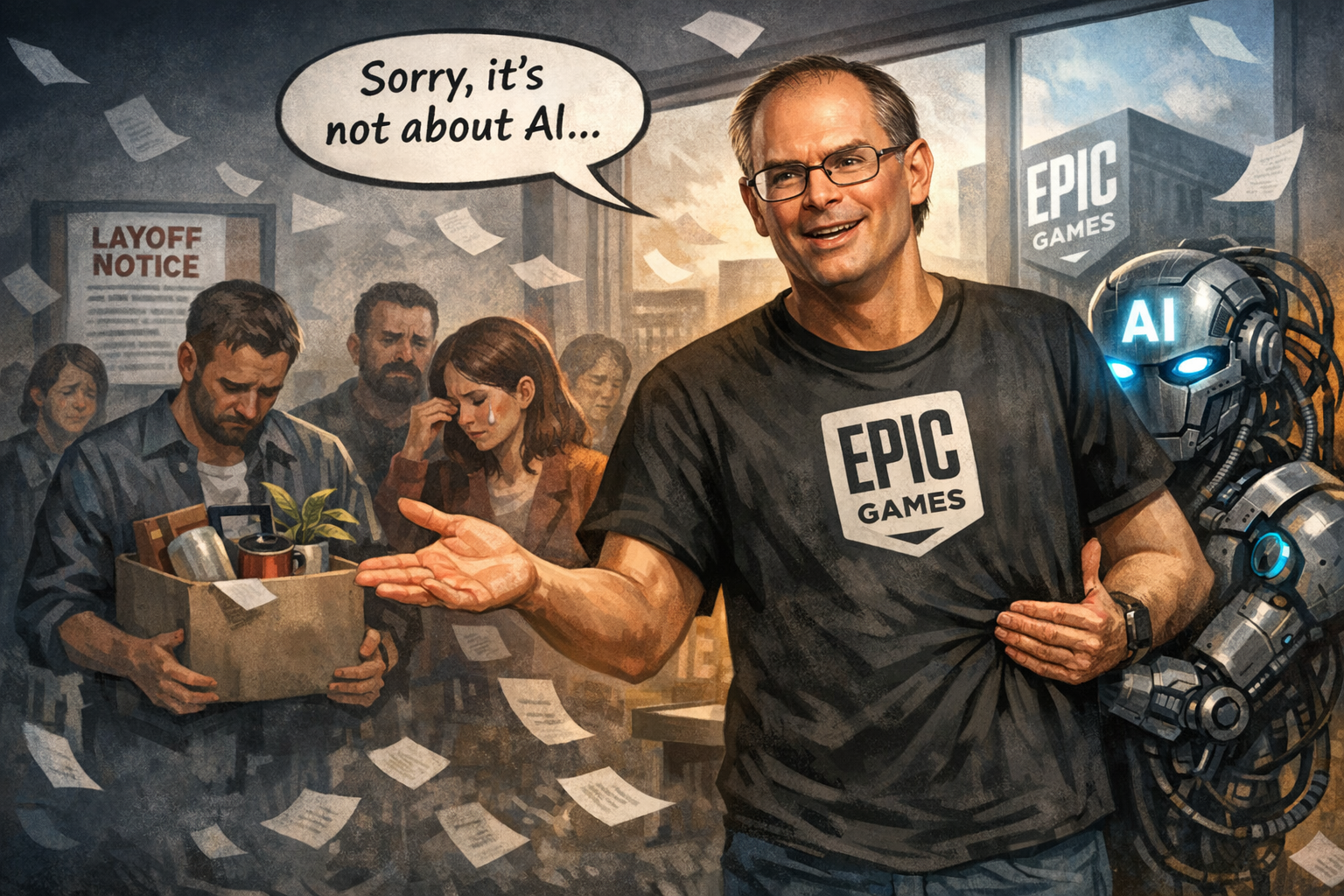
Epic Games has once again decided that the best way to “secure the future” of the company is to cut loose the very people who built it. Another round of layoffs, another round of corporate doublespeak, and another round of Tim Sweeney insisting that everything is fine, nothing is AI‑related, and definitely don’t look too closely at the direction Epic has been heading.
At this point, it’s hard not to feel like we’ve seen this movie before, and the ending never changes.
The Official Story: “Not AI‑Related”
Sweeney claims these layoffs have nothing to do with AI. According to him, this is all about “restructuring,” “efficiency,” and “focusing on core priorities.” It’s the same vague corporate language every tech CEO deploys when they want to sound responsible while doing something deeply irresponsible.
But here’s the problem: Epic has been loudly, aggressively pro‑AI for years. Sweeney has repeatedly championed AI as the future of content creation, game development, and even moderation. He’s positioned Epic as a company that wants to automate more, not less. And now, suddenly, when hundreds of people lose their jobs, we’re supposed to believe AI isn’t part of the equation.
It’s a convenient narrative, and a deeply unconvincing one.
A New Low: Telling Steam Not to Label AI‑Generated Content
If there’s one moment that really exposes Sweeney’s stance, it’s his recent criticism of Steam for requiring developers to disclose when their games use AI. Steam’s approach is simple: if AI is in your game, players deserve to know. Transparency matters.
Sweeney’s response? He argued that AI will be “in everything,” so labeling it is pointless.
That’s not just dismissive, it’s morally wrong.
There are countless players, developers, artists, and industry workers who do not support AI‑generated content, especially when it replaces human labour or is trained on unlicensed work. Many people want to avoid AI‑heavy games entirely. They want the choice. They want honesty.
Sweeney’s stance effectively encourages companies to hide AI usage, bury it, or treat it as something players don’t deserve to know about. That’s not leadership. That’s evasion. And it reinforces the idea that Epic is not interested in transparency, only in control.
Epic’s Layoffs in Context: A Brutal Industry Trend
Epic’s latest cuts reportedly affect hundreds of employees, adding to the over 10,000+ layoffs across the gaming industry in the last year alone. Studios big and small, from indie darlings to major AAA publishers, have been slashing staff at a pace the industry hasn’t seen in decades.
And let’s be honest: this probably isn’t the last time Epic swings the axe this year. The company’s direction, spending habits, and obsession with automation make further cuts feel less like a possibility and more like an inevitability.
Epic’s Financial Reality Makes This Even Worse
What makes these layoffs sting even more is that Epic isn’t some struggling startup fighting for survival. Fortnite still generates staggering revenue. Unreal Engine licensing remains one of the most powerful tools in the industry. Epic continues to pour money into legal battles, acquisitions, and metaverse experiments.
So when they claim they “have to” cut staff, it’s hard to take seriously.
This isn’t about survival, it’s about priorities. And clearly, human workers aren’t one of them.
The Hypocrisy of “Championing Creators” While Undermining Them
Epic loves to brand itself as the company that supports creators:
- Creator Codes
- UEFN
- Royalty‑free licensing
- Marketplace opportunities
But layoffs, AI evangelism, and pushing for hidden AI usage directly contradict that image. You can’t claim to empower creators while simultaneously reducing the number of actual creators on your payroll.
It’s a marketing slogan, not a philosophy.
The Ripple Effect on Unreal Engine Developers
Epic’s decisions don’t just affect Epic. They affect:
- Thousands of studios using Unreal
- Marketplace creators
- Technical artists relying on engine support
- Indie teams who depend on documentation and bug fixes
When Epic cuts staff, the entire ecosystem feels it. Bugs linger longer. Support slows down. Marketplace curation weakens. The people who rely on Unreal to make a living are left wondering whether the tools they depend on will still be properly supported.
The Human Cost Gets Buried Every Time
What gets lost in all of this, deliberately, I’d argue, is the human impact. These aren’t abstract “roles” being eliminated. These are artists, programmers, QA testers, community managers, and support staff who kept Fortnite running, kept Unreal Engine evolving, and kept Epic relevant.
And the job market they’re being thrown into? It’s brutal.
With thousands of developers all competing for the same shrinking pool of roles, finding a replacement job has become incredibly difficult. People are burning through savings, relocating, switching industries, or leaving game development entirely, not because they want to, but because they have no choice.
I genuinely feel sorry for every single person who’s been caught in this wave. They deserved better than this.
The Fear Developers Now Have About AI Replacing Them
Sweeney’s comments about AI being “in everything” don’t just sound dismissive, they fuel real fear. Developers are already anxious about automation replacing their roles. When a CEO openly downplays transparency and pushes for AI adoption while simultaneously laying off staff, it sends a clear message:
Your job isn’t safe. Your skills aren’t valued. And your concerns don’t matter.
That’s the environment Epic is helping create.
The Long‑Term Damage to the Industry
This constant cycle of layoffs is draining the industry of senior talent. Juniors can’t get hired. Studios are burning out the remaining staff. Creativity suffers when teams are terrified of being next.
Epic isn’t just reacting to the industry, they’re contributing to its decline.
Epic Wants Control, Over Creators, Over Platforms, Over the Future
Sweeney’s obsession with forcing the Epic Launcher onto everyone is part of the same mindset that leads to layoffs like this. It’s about control. Control of distribution. Control of revenue. Control of the narrative.
AI fits neatly into that worldview. It’s cheaper, it’s compliant, and it doesn’t ask for healthcare or a livable wage.
So when Sweeney says these layoffs aren’t AI‑related, it rings hollow. Maybe AI didn’t directly replace these workers today, but Epic’s long‑term strategy makes it clear where the company is heading.
The Bottom Line
Epic Games wants to present itself as a champion of creators, a rebel fighting the big bad platform holders, a visionary company building the future of interactive entertainment.
But when you peel back the PR, what you see is a company that:
- Cuts staff while investing heavily in automation
- Pushes unwanted platforms onto players
- Makes decisions that benefit executives, not employees
- Encourages companies to hide AI usage instead of being transparent
- Undermines the very creators it claims to support
- Damages the wider Unreal ecosystem with every round of cuts
Tim Sweeney can say whatever he wants about these layoffs. But actions speak louder than statements, and Epic’s actions tell a very different story
If people are replaced instead of empowered, the entire economic engine breaks down. No workers means no wages. No wages means no spending. No spending means no customers. And without customers, even the most “efficient” companies collapse. It’s a truth more people need to recognise, because if we keep heading down this path, that future isn’t hypothetical, it’s inevitable.
Until next time, stay sharp and keep gaming, Panda out.
