Posts tagged xbox

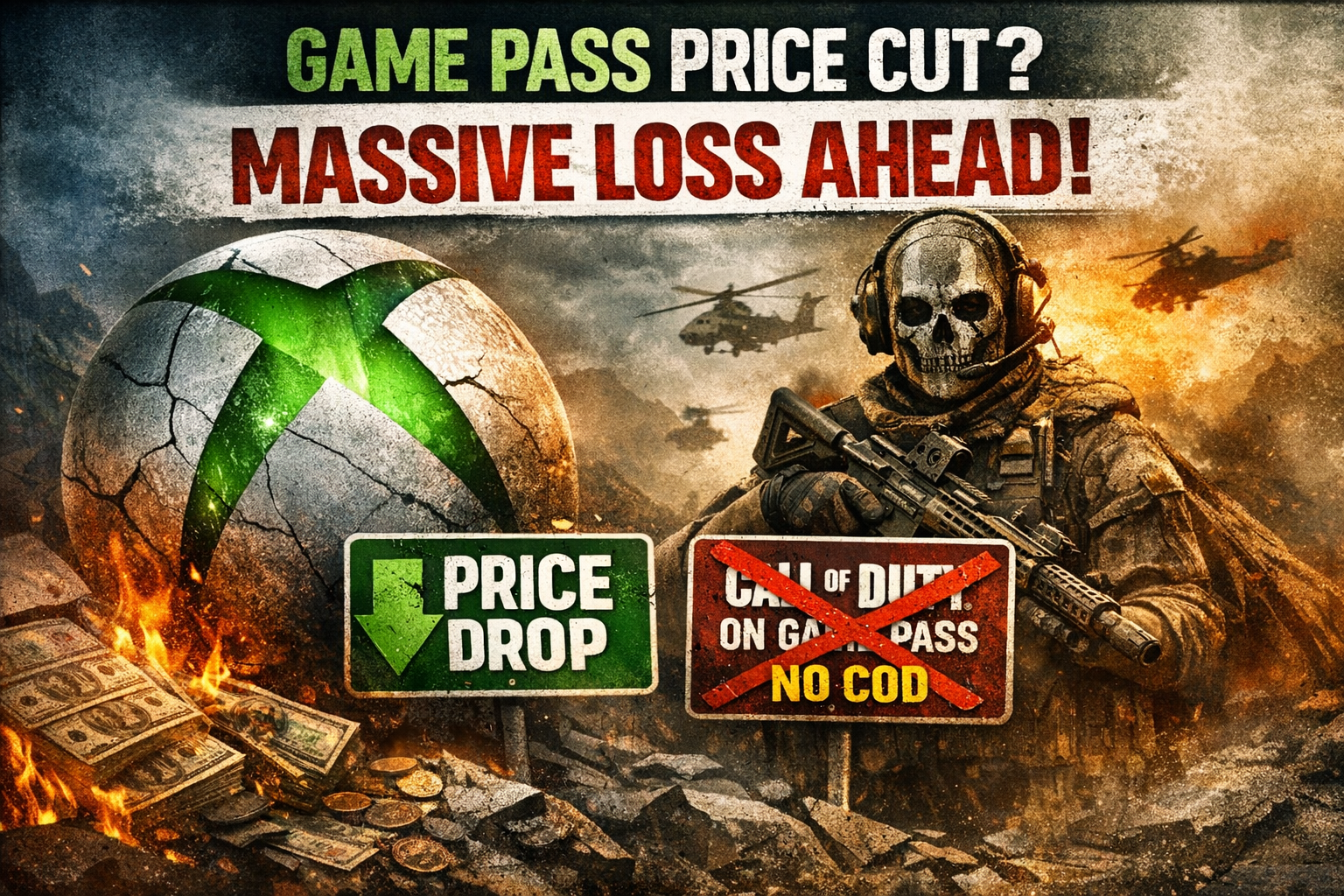
Xbox’s Game Pass Price Cut Is a Massive Loss Disguised as a Win

Xbox has announced several major changes to Game Pass all at once, a price reduction, new subscription tiers, and the confirmation that future Call of Duty titles will no longer launch Day One on Game Pass. Even though these announcements were delivered together, the overall message is clear: this is a massive loss cleverly disguised as a win.

The price cut looks good on the surface. But the value cut underneath it is far bigger.

The Price Drop Is Welcome, But It Doesn’t Balance the Loss

Cheaper Game Pass is always going to sound positive. Nobody is going to complain about paying less.

But when that “win” is paired with the removal of Day One Call of Duty releases, the entire value proposition collapses for a huge portion of the audience. Call of Duty has been one of the biggest reasons people stay subscribed, especially after Microsoft acquired Activision Blizzard.

Removing Day One access isn’t a minor tweak. It’s a fundamental shift in what Game Pass offers.

And speaking personally, I didn’t agree with the last Game Pass price increase at all, it pushed me to cancel my subscription entirely. If that rise was already too much, this new change makes the service even harder to justify.

COD‑Only Players Will Cancel in Massive Numbers

A huge part of the Call of Duty community plays only Call of Duty. They don’t browse the Game Pass library. They don’t jump between genres. They don’t care about monthly rotations.

They buy COD. They play COD. That’s their entire gaming loop.

With future Call of Duty titles no longer included on Day One, those players now have no reason to keep paying for Game Pass. Why would they pay a subscription and pay full price for Call of Duty when all they’re going to do is play Call of Duty?

This is where the real damage hits:

  • Game Pass loses a massive chunk of recurring subscribers
  • Engagement drops
  • The service becomes less appealing overall

Even with the price cut, the value for COD‑only players is effectively gone.

Not Everyone Plays COD, But Xbox Still Loses Potential Players

It’s true that many Game Pass users don’t play Call of Duty at all, and for them, this change won’t affect their daily experience.

But there’s another group Xbox is now losing:

Players who would have tried Call of Duty simply because it was included in Game Pass.

These aren’t hardcore COD fans. They’re the curious players, the ones who wouldn’t buy COD outright, but absolutely would play it if it were included at no extra cost.

By removing Day One access:

  • Xbox loses those “try it because it’s included” players
  • COD loses potential new fans
  • Engagement drops across both the game and the platform

Game Pass used to grow COD’s audience. Now it won’t.

The Loss of Xbox Exclusives Devalues Game Pass Even Further

Another major factor that can’t be ignored is the complete collapse of Xbox exclusivity. With Xbox now releasing its first‑party titles on PlayStation, Switch, and PC, the platform no longer has the unique selling point it once did.

And when exclusives disappear:

  • Game Pass loses its identity
  • The Xbox ecosystem loses its purpose
  • There’s no “must‑own” reason to stay subscribed
  • The value of the subscription becomes even harder to justify

Game Pass was originally built on the promise of exclusive Xbox titles launching Day One. Now those exclusives don’t exist, and the biggest third‑party draw, Call of Duty, is no longer Day One either.

The service is losing value from every direction.

The Activision Blizzard Purchase Forced This Shift

We always knew that buying Activision Blizzard would force a major shift in how Game Pass operates. A $69 billion acquisition doesn’t come without consequences.

And in many ways, this move proves it.

The purchase has put Xbox in a position where every possible direction creates financial problems:

  • If COD goes on Game Pass Day One → Microsoft loses billions in guaranteed sales
  • If COD stays off Game Pass Day One → Game Pass loses subscribers
  • If Game Pass prices rise → more cancellations
  • If Game Pass prices fall → revenue drops further
  • If exclusives go multiplatform → Game Pass loses its unique value

There is no winning path here, only different types of losses.

This isn’t an exaggeration. It’s the financial reality of absorbing a franchise as big as Call of Duty into a subscription model that can’t sustain it.

Expect Call of Duty Prices to Rise

With Game Pass no longer cannibalising COD sales, Microsoft has every incentive to push players back into buying the game outright. And once that becomes the norm again, price increases become easier to justify.

The pattern is predictable:

  • COD isn’t included in Game Pass
  • COD players must buy the game
  • COD becomes a premium product again
  • Prices rise to “offset” subscription losses

This isn’t speculation, it’s the logical financial outcome.

Game Pass Could Rise in Price Again Later

Even though Game Pass is cheaper today, that doesn’t mean it will stay that way.

If COD‑only players cancel, and they will, Xbox loses a huge amount of predictable monthly revenue. To make up for that, Microsoft may eventually raise Game Pass prices again or restructure tiers to recapture the lost income.

The announcements weren’t suspicious, but they were strategic. Xbox packaged the good and the bad together, but the long‑term consequences remain unchanged.

This Hurts Xbox More Than It Helps

When you look at the full picture, the direction becomes obvious:

  • Game Pass loses one of its biggest annual draws
  • COD players cancel their subscriptions
  • Xbox loses recurring revenue
  • COD becomes more expensive
  • Game Pass may eventually become more expensive again
  • Xbox loses potential COD players who would have tried it through Game Pass
  • Xbox exclusives no longer exist, removing another pillar of value
  • The Activision Blizzard purchase forces Xbox into a no‑win financial position
  • Even existing subscribers like me have already cancelled due to previous price hikes

This isn’t a strengthening move. It’s a defensive one. And it weakens the ecosystem.

Final Thoughts

Even though all the announcements were made at the same time, the outcome is still the same: this is a massive loss disguised as a win. Removing Day One Call of Duty access guts the value of Game Pass for millions of players, and the long‑term impact could be severe. Xbox may have lowered the price today, but the real cost will show up over the next year in cancellations, lost potential players, the collapse of exclusivity, revenue gaps, and inevitable pricing adjustments.

This move doesn’t build the Xbox ecosystem. It undermines it. And players will feel the effects first.

Until next time, stay sharp and keep gaming, Panda out.

Leave a comment »

Microsoft’s Xbox Studio Reshuffle: What’s Really at Stake?

Microsoft has initiated a sweeping reorganisation of its Xbox Game Studios, closing The Initiative and cancelling high-profile projects like Perfect Dark and Everwild. This strategic pivot, couched in corporate speak as “prioritising the strongest opportunities”, is more than just internal restructuring. It’s a glimpse into the fragility of creative ambition when it collides with commercial realities.

The Fallout: Cancelled Visions and Disbanded Teams

The shuttering of The Initiative marks a major deviation from the studio’s original purpose: delivering high-calibre, experimental AAA experiences. Despite being stacked with veteran talent from Crystal Dynamics and Santa Monica Studio, the Perfect Dark reboot never made it to release. Rare’s Everwild, a nature-themed title with striking artistic direction, was also abruptly scrapped.

This reshuffle has left countless developers out of work and long-nurtured projects erased. While Microsoft frames this as a necessary focus on efficiency, for many it feels like artistic erasure.

Cancelled Projects: What’s Been Lost

Microsoft’s restructuring has led to the cancellation of several high-profile and in-development projects, some years in the making. These aren’t just titles on a roadmap; they represent creative visions, studio legacies, and thousands of hours of work now consigned to history.

Confirmed Cancelled Projects

  • Perfect Dark (Reboot) – Once a flagship revival led by The Initiative, this project was scrapped alongside the studio’s closure. Despite a flashy trailer in 2024, reports suggest the footage may not have reflected actual gameplay.
  • Everwild – Rare’s ambitious, nature-themed IP was cancelled after a troubled development cycle and multiple reboots. Studio veteran Gregg Mayles departed following the decision.
  • Project Blackbird – An unannounced MMORPG from ZeniMax Online Studios, in development since 2018, was quietly cancelled amid broader cuts.
  • Romero Games’ FPS – A first-person shooter from John and Brenda Romero lost its funding after Microsoft, the unnamed publisher, withdrew support. The studio has since shut down.
  • Warcraft Rumble (Content Support) – While the mobile game remains online, Blizzard has ceased new content development, effectively sunsetting its future.

Additional Unannounced Projects

Multiple sources report that several other unannounced titles across Xbox Game Studios and partner developers were also cancelled. These include early-stage concepts and prototypes that may never be publicly disclosed, but whose loss still represents a blow to creative diversity within the Xbox ecosystem.

Strategic Shift or Financial Tightening?

Microsoft’s rationale centres on streamlining operations to maximise impact. But against the backdrop of a revenue-driven industry, where live service models dominate and risks are increasingly rare, the cancellations point to a deeper retreat from experimental, narrative-first design.

Rather than pushing boundaries, Xbox’s latest moves suggest a refocus on tried-and-tested formulas, safe franchises and scalable monetisation, where creativity often takes a backseat.

Developer Voices: Inside the Fallout

Developers haven’t held back. A Halo team member told Engadget, “I’m personally super pissed that Phil’s email to us bragged about how this was the most profitable year ever for Xbox in the same breath as pulling the lever.” That contrast between record profits and mass layoffs struck a chord across the community.

By 2022, over half of The Initiative’s staff had already departed, hinting at deeper internal struggles. Veteran Rare designer Gregg Mayles also reportedly left after Everwild’s cancellation, a symbolic loss for a studio once synonymous with bold British innovation.

Historical Context: Studios That Shaped Xbox’s Identity

  • Rare began in 1985 and was behind GoldenEye 007, Banjo-Kazooie, and Perfect Dark. After its acquisition by Microsoft in 2002, Rare transitioned from whimsical platformers to service-first titles like Sea of Thieves.
  • The Initiative was launched in 2018 with promises of autonomy and prestige. Despite its strong pedigree, management hurdles and lack of clarity around vision stifled its output. The studio closed in mid-2025, never shipping a single game.

Indie Resilience: A Counterpoint to Corporate Consolidation

Independent developers continue to flourish by leaning into authenticity. Celeste and Citizen Sleeper tackle themes like trauma, resistance, and mental health with sincere storytelling and gameplay innovation. Citizen Sleeper 2, for example, uses broken dice to metaphorically explore psychological healing.

Even Balatro, a quirky roguelike card game, earned praise for encouraging strategic adaptability, traits sorely needed in a creatively volatile industry.

The Human Cost: Thousands of Jobs on the Line

The scale of Microsoft’s restructuring goes beyond cancelled titles and closed studios, it’s a sweeping overhaul that could affect up to 2,000 jobs within its Xbox division alone. That figure represents approximately 10% of the company’s gaming workforce, hitting key teams across Rare, ZeniMax, and Turn 10. The Initiative has already shuttered, while projects like Perfect Dark, Everwild, and ZeniMax’s MMO codenamed Blackbird have been quietly scrapped.

These layoffs are part of a broader company-wide reduction estimated to impact around 9,000 employees globally, roughly 4% of Microsoft’s total workforce. The juxtaposition of these cuts with record profits has drawn sharp criticism internally, underscoring growing tension between financial performance and employee wellbeing.

Industry insiders warn that these reductions could lead to long-term creative stagnation. When experienced teams are dissolved and ambitious projects cancelled mid-development, the ripple effect is felt across future innovation and morale, especially among younger studios now hesitant to experiment or invest in bold ideas.

A Call to Action for Players and Creators

Players and creators must continue to champion diversity and boldness in gaming. This means holding studios accountable, supporting indie efforts, and demanding ethical practices in how games are made and marketed. Creative risk should be rewarded, not buried beneath restructuring memos and shareholder briefings.

Xbox may be refocusing, but the wider gaming community still has the power to steer the conversation back toward passion, artistry, and progress.

Final Thoughts

Microsoft’s studio reshuffle exposes a delicate balance between commerce and creativity. When visionary projects are cancelled, we lose more than games, we lose potential futures for the medium.

Yet, this moment also reinforces the strength of independent voices. From small studios to solo devs, resilience shines through artfully crafted experiences that resist compromise. The role of the player isn’t passive, we are curators, critics, and supporters of what gaming could be when it is led by imagination, not margin.

Until next time, stay sharp and keep gaming. Panda out.

References

Comments (1) »

Xbox Layoffs: Another Grim Chapter in a Year of Industry Turmoil

It’s happening again. According to mounting reports, Microsoft is preparing another wave of layoffs, this time targeting its Xbox division. Between 1,000 and 2,000 employees could lose their jobs, with entire studios at risk of closure. For a company that once championed “player-first” values, the ongoing pattern paints a different picture, one where profitability trumps people, and acquisitions leave creative studios in the crossfire.

A Slow-Motion Collapse

This isn’t an isolated incident. Since completing its $75 billion acquisition of Activision Blizzard in 2023, Microsoft has cut over 3,500 roles across Xbox Game Studios, Bethesda, and Activision. Despite promises of stability and growth, studios like Tango Gameworks (Hi-Fi Rush) and Arkane Austin (Redfall) were shuttered earlier this year, devastating fans and developers alike.

The looming layoffs are rumoured to hit across departments, from QA and support to entire creative teams, and may affect Xbox’s European offices as part of a broader corporate restructuring. If confirmed, this marks a serious retrenchment of Xbox’s first-party ambitions, right when confidence in the brand is already wavering.

Hardware Sales and Market Share Realities

Xbox hardware sales continue to slump. In Q2 FY25, Xbox consoles were down 29% year-over-year. In Spain, just 12,000 Xbox Series XS consoles were sold between January and June, compared to 178,000 PS5s. The disparity highlights Xbox’s increasingly tenuous grasp on global markets and a weakening position against competitors, even as it ports core titles like Forza Horizon 5 and Gears of War Reloaded to rival platforms.

AI and the Shift in Priorities

Microsoft’s broader pivot toward AI and enterprise services has left Xbox competing for oxygen. With over $80 billion committed to AI research and infrastructure, Xbox, once seen as a cornerstone of Microsoft’s consumer strategy, is being reshaped or sidelined to align with corporate priorities. These layoffs suggest that gaming, while still profitable, is no longer central to Microsoft’s long-term vision.

Brand Identity Crisis

With Xbox-exclusive titles launching on PlayStation and Nintendo platforms, and reports suggesting the next-gen Xbox may operate more like a boutique Windows PC, the brand is caught in an identity crisis. Is Xbox still a platform, or just a publishing label? The current restructuring doesn’t offer clarity, it deepens the ambiguity.

The Cost of “Big Gaming”

This is the byproduct of unchecked consolidation. Microsoft’s megamerger was supposed to bring resources and reach to storied studios. Instead, it’s yielded further centralisation, cost-cutting, and eroded autonomy. The promised creative renaissance looks increasingly like corporate streamlining, where talent becomes collateral damage.

And with Game Pass failing to meet aggressive internal growth targets, and hardware sales stagnating, Xbox seems to be pivoting from an expansive vision to a defensive posture. One where shareholder expectations are prioritised over long-term community trust or developer well-being.

A Reckoning Still to Come

Layoffs aren’t just metrics, they’re lives, careers, and communities disrupted. As more studios vanish into spreadsheets, players are left wondering: Who’s next? And what kind of industry are we enabling when art and innovation are beholden to quarterly earnings?

These aren’t growing pains. They’re warning signs.

Final Thoughts

The Xbox layoffs aren’t just a business move, they’re a signal flare. As the industry doubles down on consolidation, AI pivots, and shareholder appeasement, the very foundations of what made gaming compelling, creativity, risk-taking, and human touch, are under threat. Microsoft’s choices reflect a broader pattern across the industry, where innovation is increasingly sacrificed for efficiency, and vision is traded for volatility.

Players, developers, and independent creators deserve more than fleeting promises and disappearing studios. It’s time we rethink what growth in gaming should look like, and who pays the price when it’s mishandled.

Until next time, stay sharp and keep gaming. Panda out.

References

Comments (1) »