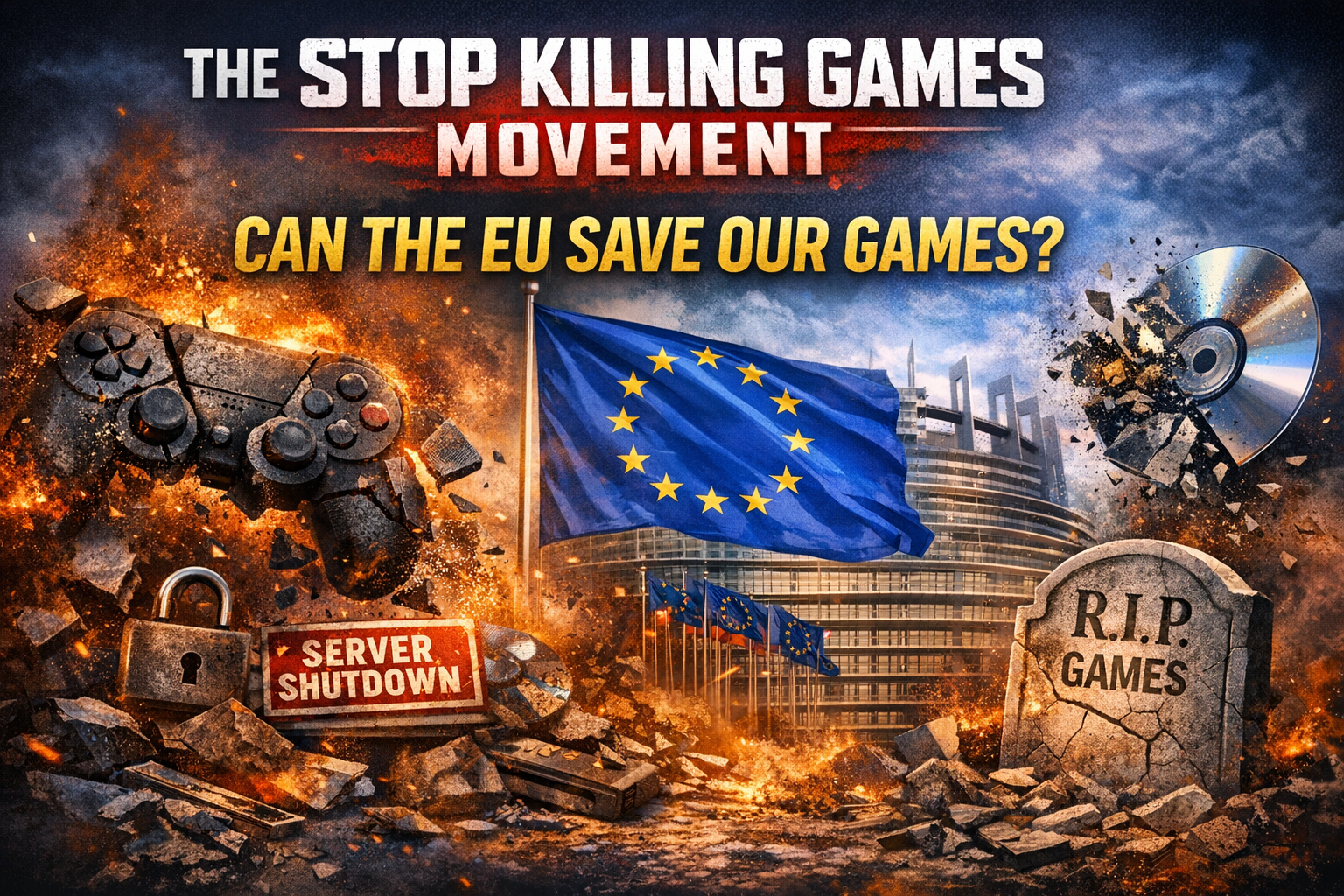
Over the past year, players have watched a worrying trend accelerate across the games industry: online‑only titles being shut down permanently, single‑player games rendered unplayable due to server checks, and purchased content disappearing without warning. High‑profile shutdowns, including games that were only a year or two old, pushed many players to a breaking point.
But the moment that truly ignited the movement was Ubisoft’s decision to shut down The Crew (2014). Despite being a paid game with an active community, Ubisoft delisted it from all storefronts and later shut down the servers, rendering the entire game, including single‑player, completely unplayable. No offline mode, no preservation patch, no way for owners to access what they paid for. For many players, this was the moment that proved the industry had crossed a line, and it became the rallying cry that propelled the Stop Killing Games movement into the public spotlight.
What began as a grassroots pushback has now reached the desks of EU officials, and for the first time, a major governing body is openly examining whether consumer protection laws need to evolve to keep up with the modern games industry.
This isn’t just noise anymore. It’s becoming policy discussion.
But where does the movement stand today? And what is the EU actually saying in response?
Let’s break it down.
What the Movement Is Fighting Against
The Stop Killing Games movement argues that the industry has shifted into a dangerous pattern:
- Games being shut down after only a year or two
- Online‑only DRM making single‑player titles unplayable
- Delisted games disappearing forever
- Purchased content being removed
- Live‑service titles being abandoned with no fallback mode
- No legal requirement for publishers to keep games functional
The core message is simple:
If you buy a game, you should be able to play it, even if the servers go offline.
This resonates with players because it’s rooted in fairness. But it also raises complex legal and technical questions.
The Movement’s Most Powerful Arguments, And Why They Hit Hard
One of the reasons the Stop Killing Games movement gained so much traction is because it highlights something most players never stop to think about: video games are the only major entertainment medium where a company can legally take away something you paid for.
The movement uses several strong comparisons to make this point clear:
1. Books don’t disappear from your shelf
If you buy a book, physical or digital, the publisher cannot:
- revoke it
- delete it
- make it unreadable
- shut it down
Once you’ve bought it, it’s yours.
2. Films don’t stop working after a few years
If you buy a Blu‑ray or a digital film, the studio cannot:
- disable playback
- remove scenes
- shut down the servers required to watch it
Even streaming services don’t delete films you’ve purchased.
3. Music doesn’t become unplayable because a server goes offline
If you buy an album, the label can’t:
- revoke your license
- remove tracks
- make the file stop working
Music preservation is legally protected.
4. Even software industries have fallback protections
Professional software often includes:
- offline modes
- perpetual licenses
- compatibility patches
Games, by contrast, can be rendered useless overnight.
Why Games Are Treated Differently, And Why That’s a Problem
The movement argues that games are the only digital product where:
- a company can shut down a server
- and instantly destroy the product you paid for
- with no legal obligation to provide a fallback
This is the core injustice the movement highlights.
And it’s exactly this comparison that caught the attention of EU officials.
The EU Has Officially Acknowledged the Issue
The movement gained enough traction that the European Commission was formally petitioned, and they responded.
Thierry Breton, EU Internal Market Commissioner, stated:
“Consumers must have access to the digital content they have purchased. If a game is no longer supported, companies must ensure that users can continue to enjoy what they paid for.”
This is one of the strongest statements yet from a major regulator. It aligns almost perfectly with the movement’s goals.
But the EU’s stance isn’t entirely one‑sided.
The EU’s Position: Supportive, But Cautious
The European Commission has made it clear they are examining the issue, not legislating it, at least not yet.
In their official response:
“The Commission is aware of concerns regarding the preservation of digital games and the discontinuation of online services. We are examining whether current consumer protection rules adequately address these situations.”
This is supportive, but measured. They’re acknowledging the problem, not promising sweeping regulation.
Why the caution?
Because the EU has to balance:
- consumer rights
- developer freedom
- technical feasibility
- preservation laws
- cross‑border digital markets
They can’t simply force publishers to keep servers online forever. But they can explore requirements like:
- offline modes
- patches to keep games functional
- legal preservation exemptions
- clearer consumer rights for digital goods
And that’s exactly what they’re doing.
What EU Parliament Members Are Saying
Several MEPs have spoken publicly about digital goods and consumer rights, not always directly about games, but in ways that apply perfectly to this issue.
MEP Kim van Sparrentak (Greens/EFA):
“We cannot allow companies to sell digital products that can be taken away at any moment. This undermines consumer trust.”
MEP Brando Benifei (S&D):
“If a product is sold, it must remain usable. This principle must apply to digital products just as it does to physical ones.”
IMCO Committee (Internal Market):
“When consumers buy a product, they expect it to remain functional. Digital goods should not simply disappear.”
These statements show a clear trend: The EU is leaning toward the movement’s side, at least philosophically.
But again, philosophy isn’t legislation.
Is There Any Pushback Against the Movement?
Here’s the balanced view.
1. The EU has not criticised the movement directly.
There are no public EU statements against Stop Killing Games.
2. The pushback is structural, not ideological.
The EU’s concerns are about:
- how to enforce preservation
- who pays for it
- whether offline modes are technically possible
- how to regulate global publishers
- avoiding over‑regulation of creative industries
3. Publishers themselves have been mostly silent.
They haven’t publicly opposed the movement, but their actions (shutting down games, delisting titles, using online DRM) speak louder than words.
So the “opposition” isn’t vocal. It’s practical.
Where Things Stand Today
Here’s the honest, factual picture:
The Movement
- Loud
- Organised
- Growing
- Clear in its demands
- Supported by players and preservationists
The EU
- Acknowledges the issue
- Has responded officially
- Is reviewing consumer protection laws
- Has expressed support for the underlying principles
- Has not drafted legislation yet
- Is cautious about feasibility and scope
Publishers
- Not publicly engaging
- Continuing business as usual
- Likely waiting to see if regulation becomes real
This is not a fight with two equal sides. It’s a movement pushing hard, and a regulator cautiously listening.
Why This Matters for the Future of Games
If the EU eventually regulates this area, even lightly, it could reshape the industry:
- Games may be required to include offline modes
- Publishers may need to provide “sunset patches”
- Delisted games may need preservation pathways
- Consumers may gain stronger digital rights
- Subscription services may face new rules
- DRM practices may be restricted
And because global publishers rarely build region‑specific versions, EU rules often become global standards.
This is why the movement is focusing so heavily on the EU. It’s the one body with the power to force industry‑wide change.
Final Thoughts
The Stop Killing Games movement has done something rare: It has pushed a major governing body to publicly acknowledge a problem the industry has ignored for years.
The EU isn’t promising sweeping reform, not yet. But they’re listening, they’re reviewing, and they’re quoting principles that align strongly with the movement’s goals.
The balance right now looks like this:
- The movement is loud and clear.
- The EU is cautiously supportive.
- Publishers are silent but watching.
Whether this becomes real legislation or remains a political conversation depends on what happens next, but for the first time, players aren’t shouting into the void.
They’re being heard.
Until next time, stay sharp and keep gaming, Panda out.
References
- Hore, J., 2024. Stop Killing Games Receives Support From Politicians in European Parliament Hearing. Gaming News.
- European Commission, 2024. Stop Destroying Videogames — European Citizens’ Initiative (ECI) Registration & Objectives.
- Peq42, 2024. Stop Killing Games MASSIVE W with New Legislation and EU Hearings. Peq42 Gaming Blog.
- Mankar, S., 2024. Stop Killing Games Reaches European Parliament: Everything That Was Said at the Brussels Hearing. Gaming Amigos.
- Reynolds, O., 2024. “It Will Have A Chilling Effect On Game Design” — EU Group Responds to Stop Killing Games. Nintendo Life.
- Ubisoft, 2024. The Crew (2014) Server Shutdown and Delisting Announcement. Ubisoft Support Communications.

Leave a comment