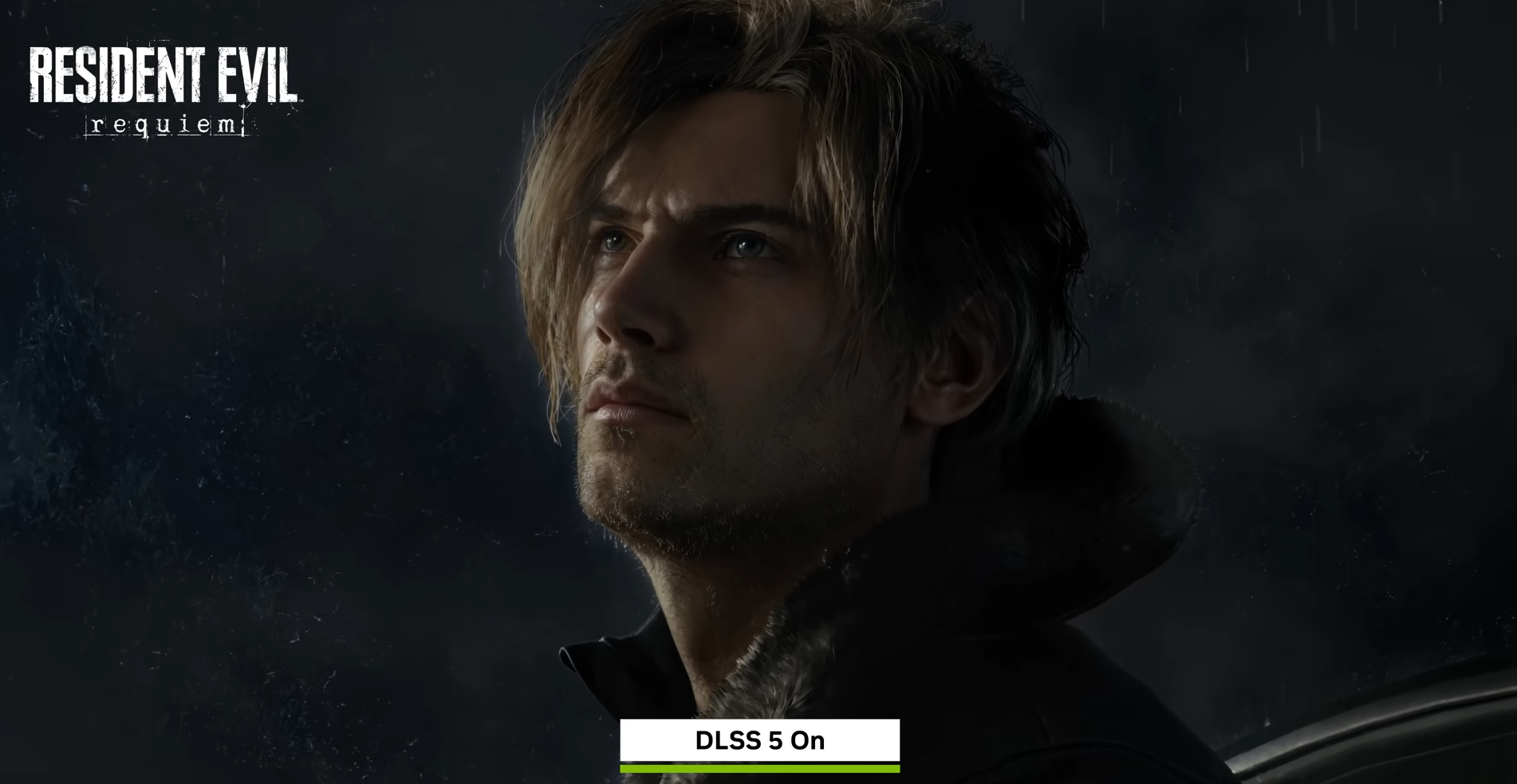
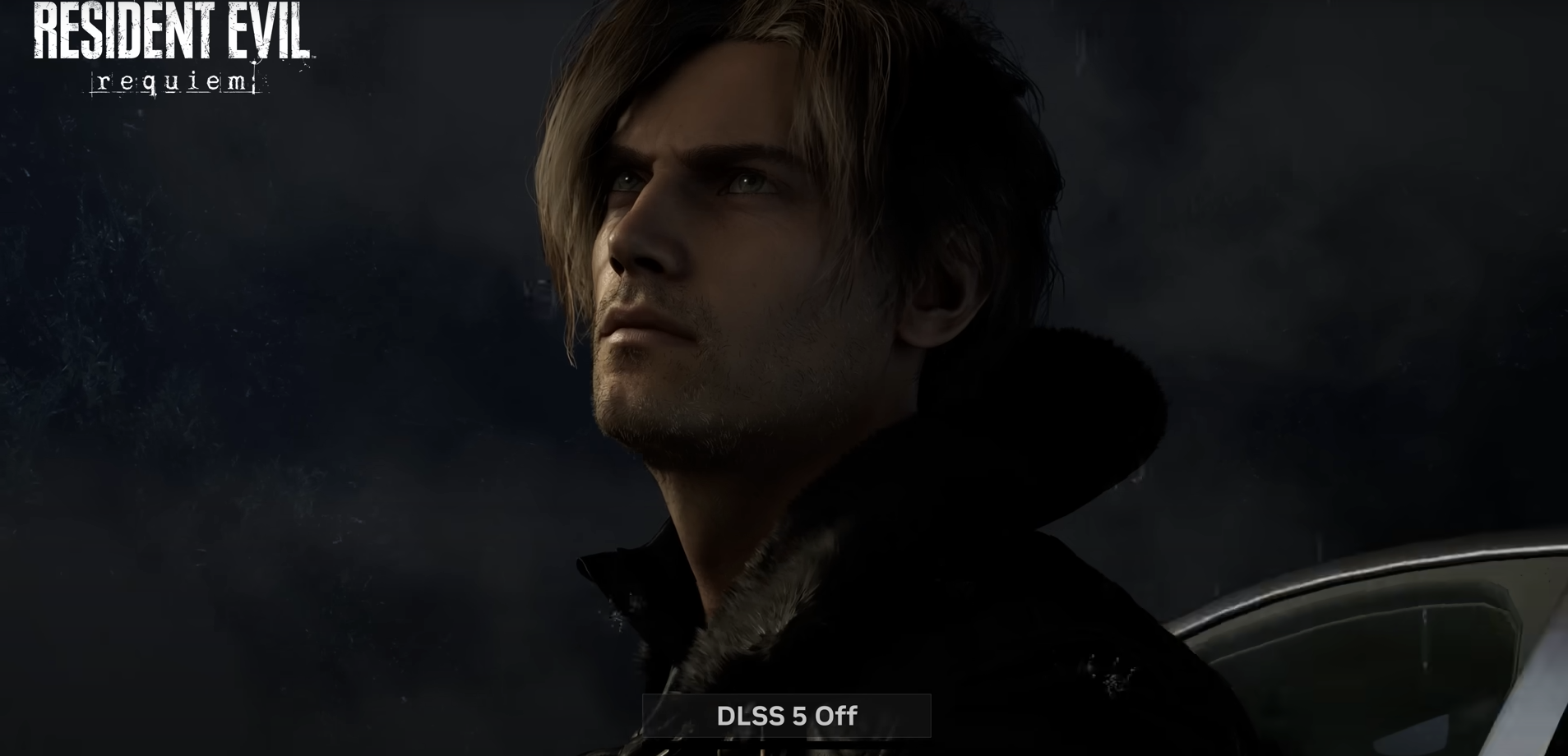
NVIDIA’s DLSS 5 announcement should have been a milestone for graphics technology. Instead, it’s become a flashpoint, a moment where gamers, artists, and developers are forced to confront a future where AI doesn’t just enhance games, but rewrites them. And honestly? It feels like the industry is sprinting toward a future nobody actually asked for.
DLSS used to be a clever performance trick. Now it’s an AI-driven filter layered over entire games, altering lighting, materials, and even the emotional tone of scenes. That’s not optimization. That’s overreach.
And the more we see, the more it feels like AAA studios are ready to let AI do the heavy lifting, even if it means sacrificing the art that makes games meaningful.
DLSS 5 Doesn’t Respect Art Direction, It Replaces It
Early footage shows DLSS 5 doing far more than upscaling. It’s injecting its own interpretation of lighting, materials, and geometry. Scenes look glossier, smoother, or outright different from what the artists created.
Gamers immediately noticed:
- Faces looking subtly altered
- Materials gaining an unnatural sheen
- Lighting shifting toward a “photoreal” style that clashes with the original tone
And the most worrying part?
Every game enhanced with DLSS 5 starts to look the same.
What NVIDIA showed in their announcement wasn’t a celebration of artistic diversity, it was a preview of a homogenised future. The “enhanced” images all shared that unmistakable AI sheen: overly smooth surfaces, exaggerated lighting, and a kind of artificial clarity that feels more like an Instagram filter than a rendering technique.
It’s the same problem we see with AI art models:
everything starts to blend together.
Games are art. They’re built by teams who obsess over mood, colour, texture, and atmosphere. When an AI model starts repainting the world in real time, the original artistic intent gets buried under algorithmic guesswork.
A Shortcut for AAA Studios to Get Even Lazier
Let’s be honest: big studios already rely on procedural filler, outsourced assets, and day‑one patches. DLSS 5 feels like the next step in that trend, a tool that lets publishers cut corners and let AI “fix” the visuals later.
Why spend months perfecting lighting or materials when DLSS 5 can slap a photoreal filter over everything?
Why polish textures when the AI can “enhance” them on the fly?
This isn’t empowering developers. It’s enabling shortcuts.
And when NVIDIA is investing billions into generative AI, it’s hard not to see DLSS 5 as part of a broader push to normalise AI‑altered media, regardless of whether players want it.
Gamers Don’t Want This, And They’re Not Quiet About It
The backlash has been overwhelming. Across forums, social media, and comment sections, players are calling DLSS 5:
- “AI slop”
- “A filter nobody asked for”
- “The death of artistic direction”
- “A tech demo pretending to be a feature”
People aren’t rejecting DLSS 5 because they “don’t understand it.” They’re rejecting it because they do understand what it means for the future of game art.
Gamers want authenticity, not algorithmic reinterpretation.
And to be clear, this isn’t about hating DLSS as a whole.
DLSS has been a genuinely brilliant technology for years. The way it helps people with lower‑spec PCs enjoy modern games is one of the best things to happen to PC gaming. That’s where DLSS shines, boosting performance, smoothing out framerates, and making demanding titles accessible to more players.
But changing the way DLSS works at a fundamental level is not the way forward.
AI absolutely has its uses, but the way DLSS 5 applies an AI filter over the entire image isn’t enhancement, it’s distortion. It stops being a performance tool and starts becoming an artistic override, and that’s where the line gets crossed.
Studios Are Already Defending DLSS 5, And They’re Naming AI as the Future
Several studios partnering with NVIDIA have stepped in to defend DLSS 5. Their statements are predictable, but now we can attach names, context, and motivations to them.
Todd Howard, Bethesda Game Studios (Director & Executive Producer)
Todd Howard has been openly enthusiastic about NVIDIA’s AI‑driven rendering. While discussing Starfield’s tech pipeline, he praised AI‑assisted upscaling as “the future of how we push visual fidelity without sacrificing performance.”
Howard has repeatedly emphasised that AI‑based rendering lets studios “focus on the bigger picture,” which aligns perfectly with NVIDIA’s messaging around DLSS 5.
Bethesda’s long‑standing partnership with NVIDIA makes their support unsurprising, but it also highlights how deeply AI is being woven into AAA pipelines.
CD Projekt Red, Jakub Knapik (Global Art Director)
Knapik has praised DLSS and AI‑assisted rendering for years, calling it “a natural evolution of game visuals.”
His stance on DLSS 5 mirrors this: AI is the next step, and players should embrace it.
Remedy Entertainment, Tero Virtala (CEO)
Virtala has been vocal about AI‑driven rendering, stating that technologies like DLSS “free up resources and let teams focus on creative direction.”
This is the same corporate line being repeated around DLSS 5.
Ubisoft, Pierre Escaich (Technical Director)
Ubisoft has already announced internal initiatives to use AI for writing NPC dialogue, generating animations, and assisting with world‑building.
Escaich’s stance on DLSS fits that direction, saying NVIDIA’s AI tools “bring out details that would otherwise be lost.”
Ubisoft’s growing reliance on AI makes their support for DLSS 5 feel less like artistic enthusiasm and more like corporate alignment.
Square Enix, Takeshi Aramaki (Studio Head, Luminous Productions)
Square Enix has openly stated they plan to integrate AI into “every stage of game development.”
Aramaki has previously described DLSS as “a key part of achieving next‑generation visuals,” and their support for DLSS 5 fits perfectly with their broader AI‑first strategy.
Square Enix is one of the most aggressive AAA publishers pushing AI into production, from asset generation to animation, so their backing of DLSS 5 is no surprise.
Developers Speaking Out Against DLSS 5
While some studios are defending DLSS 5, several developers have openly criticised it, echoing the same concerns gamers have raised. Their reactions reinforce the idea that DLSS 5 isn’t just controversial — it’s actively worrying people who work on games for a living.
Grace Ashcroft, Developer on Resident Evil: Requiem
Eurogamer reported that Grace Ashcroft was “concerned that DLSS 5 appears to layer a gaudy AI filter over a game’s original work.” She noted that the tech “changes the look of scenes in ways we didn’t author,” which directly challenges NVIDIA’s claim that artistic intent remains untouched.
Unnamed Developers Reacting to NVIDIA’s Demo
According to TheSixthAxis, multiple developers watching the DLSS 5 reveal said it “looks like someone has put an AI beauty filter over the games.” This wasn’t a fringe opinion, it was described as the reaction from “almost everyone else, from punters to game developers.”
General Developer Sentiment (as reported by GamingOnLinux)
GamingOnLinux highlighted widespread developer frustration, noting that DLSS 5 “completely changes the faces of characters” and that many devs felt NVIDIA had “lumped together their previous good tech with something else entirely.” The article emphasised that developers were just as baffled as players by the AI‑generated look.
Developers Calling It “AI Slop”
XDA Developers reported that even developers were describing the output as having an “unnecessary AI sheen” and comparing it to “AI slop.” This wasn’t just a gamer meme, it was a professional critique.
The Pattern Is Clear
These quotes all share the same tone:
- AI saves time
- AI reduces workload
- AI “enhances” visuals
- AI is the future
But none of them address the core issue gamers are raising:
DLSS 5 doesn’t just enhance games, it homogenises them.
It overwrites artistic direction with an AI‑generated aesthetic that makes every game look like the same glossy, over‑processed tech demo. And the studios defending it are the same ones already investing heavily in AI‑driven production pipelines.
Gamers aren’t imagining the threat.
The industry is telling us exactly where it wants to go.
NVIDIA’s Response to the Backlash Isn’t Helping
The backlash grew so loud that NVIDIA’s CEO, Jensen Huang, addressed it directly. His stance was blunt:
- Critics are “misunderstanding the technology”
- DLSS 5 “does not override artistic intent”
- Developers “remain fully in control”
But the demos contradict that narrative. When the AI is visibly altering materials, lighting, and even character appearance, it’s hard to argue that the original art direction is untouched.
Even long‑time DLSS supporters and tech journalists are calling this a step too far.
Games Deserve Better Than AI Overpainting
At the core of all this, my stance hasn’t changed:
Games should look the way their creators intended, not the way an AI model thinks they should.
We already have incredible rendering tools. We don’t need a generative AI system repainting games in real time. That’s not innovation. That’s intrusion.
DLSS 5 isn’t helping games.
It’s homogenising them.
It’s sanding down the edges.
It’s replacing art with algorithmic interpretation.
And if this is the direction AAA gaming is heading, AI filters, AI textures, AI lighting, AI “enhancements”, then we’re at risk of losing the human touch that makes games special in the first place.
Until next time, stay sharp and keep gaming, Panda out.
References
- “DLSS 5 Announcement & Feature Overview” — NVIDIA
- “NVIDIA CEO Responds to DLSS Criticism” — Tom’s Hardware
- “Jensen Huang Defends DLSS Against AI Concerns” — PC Gamer
- “Todd Howard Talks Starfield Technology and AI Upscaling” — IGN
- “Todd Howard on NVIDIA and the Future of Visual Fidelity” — GamesRadar
- “CD Projekt Red Discusses DLSS and AI Rendering” — PC Gamer
- “Cyberpunk 2077 Developers on DLSS Improvements” — TechRadar
- “Remedy CEO Tero Virtala on AI Rendering and Studio Direction” — GamesIndustry.biz
- “Remedy Discusses AI Rendering and the Future of Visuals” — Eurogamer
- “Ubisoft Introduces Ghostwriter AI Narrative Tool” — Ubisoft News
- “Ubisoft’s AI Writing Tool Raises Questions” — The Verge
- “Ubisoft Expands Use of AI Tools in Development” — PC Gamer
- “Square Enix Outlines AI Strategy for Future Games” — Square Enix
- “Square Enix Plans AI Integration Across Development Pipeline” — PC Gamer
- “Square Enix Wants AI in Every Stage of Game Development” — TechSpot
- “Developers Express Concerns Over DLSS 5 Visual Changes” — Eurogamer
- “DLSS 5 Backlash From Developers and Players” — TheSixthAxis
- “Developers Criticise DLSS 5’s AI‑Generated Look” — GamingOnLinux
- “Developers Call DLSS 5 Output an ‘AI Sheen’” — XDA Developers
- “DLSS 5 Backlash Discussion” — r/pcgaming
- “DLSS 5 Technical Analysis” — Digital Foundry
- “DLSS 5 Community Reaction and Concerns” — PC Gamer