Posts tagged nintendo

Nintendo’s Patent Pushback

The Pokémon Company and Nintendo have never been shy about guarding their IP, but their latest legal manoeuvres against indie developer Pocket Pair are raising eyebrows across the gaming community, and not for the usual reasons.

At the centre of the storm is Palworld, the wildly popular “Pokémon with guns” survival game. Nintendo claims the game infringes on several core Pokémon mechanics, specifically patents related to creature-catching, combat interactions, and mount-switching behaviour. But rather than letting the suit play out as-is, Nintendo has taken the unusual step of rewording one of its active patents mid-case, prompting critics to call it a stretch, or worse, a strategic smokescreen.

Shifting Patents and Strange Moves

The revised patent now includes language like “even when,” which might sound harmless, but in legal circles, it’s seen as slippery phrasing. Florian Mueller, a respected IP specialist, described the wording as “extremely contorted,” suggesting the rewrite weakens the patent’s clarity. It seems designed to broaden the scope, possibly snagging more games and mechanics in the legal net.

It’s a rare move, and one that signals Nintendo may lack confidence in the original claim’s enforceability.

Pocket Pair’s Response and Tweaks

Pocket Pair isn’t exactly folding under pressure. They’ve already rolled out updates tweaking creature animations, removing gliding features, and altering the Pal Sphere system, all in an effort to distance Palworld from direct comparisons with Pokémon.

Their defence also points to design precedents from games like Titanfall 2, Rune Factory, and Monster Hunter Stories, arguing that these mechanics existed well before Nintendo’s patents were even filed.

What’s at Stake

Beyond Palworld and Pokémon, this case raises deeper concerns about how game mechanics are treated under intellectual property law. If broadly worded patents are used to gatekeep systems like mount-switching or monster catching, staples across gaming genres, then smaller studios may start avoiding innovation out of fear, even when the mechanics aren’t proprietary.

Legal overreach like this creates a chilling effect. It’s not just about protecting IP, it’s about deciding who gets to build on shared design foundations and who doesn’t.

Mechanics at Risk – Shared Ideas, Not Stolen Designs

To put things in perspective, here’s a breakdown of how common gameplay mechanics have been used across AAA titles and indie projects alike, often decades before Nintendo’s latest patent revisions:

MechanicAAA ExamplesIndie ExamplesFirst Appearance (Approx.)
Creature TamingPokémon, ARK: Survival EvolvedPalworld, Temtem1996 (Pokémon Red/Blue)
Mount SwitchingBreath of the Wild, World of WarcraftChocobo GP, Palworld1994 (Final Fantasy VI)
Inventory CraftingFallout 4, Skyrim, MinecraftValheim, Don’t Starve, Core Keeper2007 (Minecraft)
Ricochet ShootingTitanfall 2, Max PayneRoboCop: Rogue City2001 (Max Payne)
Companion UpgradesMass Effect, Dragon AgeInto the Breach, Wasteland 32006 (Mass Effect)
Environmental HealingBorderlands, FalloutPalworld, The Long Dark2008 (Fallout 3)
Turret HackingWatch Dogs, Deus Ex: Human RevolutionRoboCop: Rogue City, République2011 (Deus Ex: HR)
Safe CrackingThief, Fallout: New VegasRoboCop: Rogue City, The Escapists1998 (Thief: The Dark Project)

These mechanics aren’t owned, they’re iterated, evolved, and borrowed like ingredients in a shared design pantry. Claiming monopoly over them risks turning creativity into a courtroom formality.

Final Thoughts

Whether Nintendo’s approach is a defensive overreach or a justified reaction to imitation, one thing’s clear, this case could reshape how we define ownership in game mechanics. As for Pocket Pair, their willingness to adapt without folding completely sets a bold precedent. Indie devs, take notes.

It’s a crossroads moment for game design: protect innovation, or bury it under bureaucracy. Fans, critics, and developers alike should be paying close attention, because the outcome could impact how we play for years to come.

Until next time, stay sharp and keep gaming, Panda out.

Reference List

Legal Case and Patent Details

Gameplay Mechanics Precedents

Comments (1) »

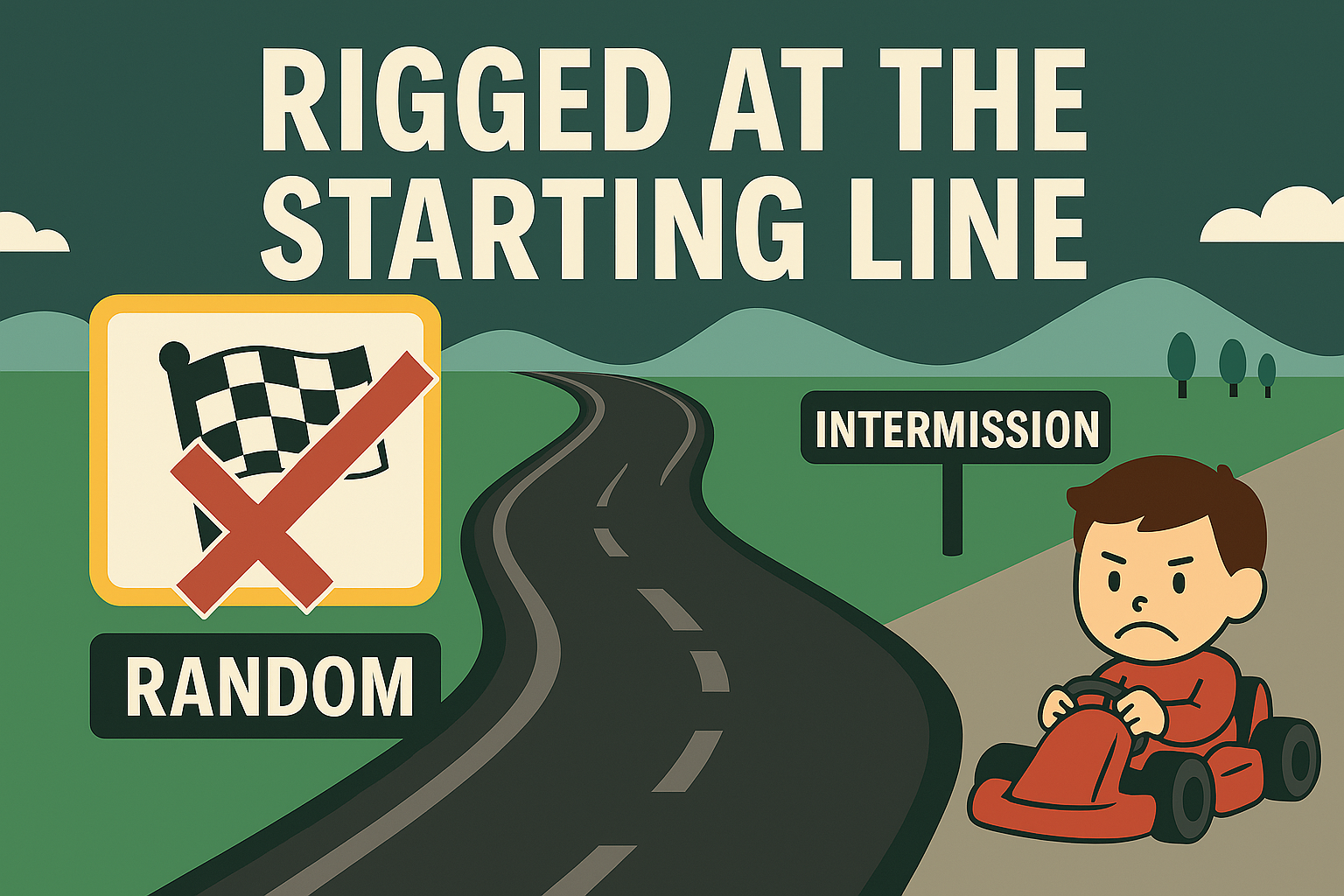
Nintendo’s “Random” Isn’t Random Anymore, And Mario Kart World Players Aren’t Having It

In a franchise built on speed, chaos, and choice, Nintendo has just slammed the brakes on one of Mario Kart World’s most beloved workarounds. The latest update has quietly, but significantly, altered how online matchmaking works, and fans are calling foul.

The Trick That Made Online Play Bearable

Until recently, Mario Kart World players had discovered a clever way to bypass the game’s divisive intermission tracks, long, linear segments that connect one course to another. These intermissions often eat into lap counts and feel more like filler than fun.

The workaround? Pick “Random.” This option reliably dropped players into classic three-lap races, skipping the intermission slog entirely. It became the go-to choice in online lobbies, with entire groups defaulting to Random just to get a proper race.

The Update That Changed Everything

Nintendo’s latest patch (Ver. 1.1.2) “adjusted courses selected in ‘Random’”, a vague phrase that, in practice, means Random now includes intermission tracks. The result? Players who once had a reliable escape now find themselves funneled back into the very content they were trying to avoid.

This isn’t just a technical tweak, it’s a philosophical one. Nintendo is effectively saying: You will play the game our way.

Community Reaction: Furious, Frustrated, Fed Up

The backlash has been swift and vocal:

  • “They removed the one saving grace of online play,” one player lamented
  • Others say the change has “killed” the online mode entirely
  • YouTuber PapaGenos summed it up: Give players options. Don’t force this stuff.”

Even casual players are noticing the shift, with many reporting that the joy of quick, satisfying races has been replaced by tedious transitions and unpredictable pacing.

Review Bombing Hits Metacritic

The frustration has spilled over to Metacritic, where Mario Kart World is now being review bombed. The user score has dropped from around 8.3 to 7.5 in just a few days, with a surge of negative reviews citing the forced intermission tracks as the tipping point.

Some users have gone as far as rating the game 0/10, not because the core gameplay is broken, but to protest Nintendo’s refusal to listen.

User Review Quotes

“This devastating update has cost Mario Kart any and all fun.”
Hyprawave, Metacritic

“I feel scammed. I bought this game for racing, not for driving through empty roads.”
Phoenix89CT, Metacritic

“Nintendo is ruining the online experience. Bring back the 3-lap races.”
User review, TheGamer

Nintendo’s History of Controlling Competitive Play

If the Mario Kart World update feels familiar, that’s because it is. Nintendo has a long-standing pattern of reining in player-discovered mechanics or community-driven preferences, even when those elements become central to competitive play.

A prime example? Wavedashing in Super Smash Bros. Melee.

Wavedashing was a movement technique discovered by players shortly after Melee’s release. By air dodging diagonally into the ground, characters could slide while retaining full control, allowing for advanced spacing, combos, and mind games. It became a cornerstone of high-level play.

But Nintendo wasn’t thrilled. In Super Smash Bros. Brawl, wavedashing was deliberately removed to make the game more accessible to casual players. This decision sparked years of tension between Nintendo and the competitive Smash community, who saw it as a dismissal of their skill and dedication.

Just like wavedashing, the “Random” course selection trick in Mario Kart World was a player-discovered workaround that enhanced competitive enjoyment. And just like before, Nintendo has stepped in, not to refine it, but to shut it down.

Why This Matters

This isn’t just about track selection, it’s about player agency. Nintendo has a long history of controlling how its games are played, often at the expense of community-driven innovation. From Smash Bros. tournament restrictions to mod takedowns, the pattern is familiar.

In Mario Kart World, the intermission tracks may be a core design feature, but forcing them on players who clearly prefer traditional races feels tone-deaf at best, and antagonistic at worst.

What Could Fix It?

  • Separate matchmaking pools: One for intermission-style races, one for classic three-lap formats
  • A toggle in settings: Let players opt out of intermissions entirely
  • Transparency: Explain the design intent behind the change, and listen to feedback

Final Thoughts

Nintendo’s decision to override player preference in Mario Kart World may seem minor on paper, but it strikes at the heart of what makes online gaming thrive: choice, community, and respect for how people want to play. By removing a workaround that players organically embraced, Nintendo has turned a clever bit of community adaptation into a flashpoint of frustration.

If the company wants to maintain goodwill, especially as it eyes the future of the Mario Kart franchise, it needs to remember that control doesn’t always equal quality. Sometimes, the best course is the one players choose for themselves.

Until next time, stay sharp and keep gaming. Panda out.

References

Comments (1) »

Nintendo’s Switch 2 Crackdown: Anti-Piracy or Anti-Consumer?

Image – Nintendo Switch 2

Nintendo has reignited controversy with its latest move to brick Switch 2 consoles that detect unauthorised third-party devices, specifically, the MIG Flash V2 cartridge. Touted as a tool for game preservation or homebrew use by some, the cartridge has now become ground zero in a sweeping wave of console bans.

Error 2124-4508: The Death Sentence

Users report being met with the dreaded Error Code: 2124-4508, which restricts all online activity and cripples core functionality. Once issued, the ban is permanent, even a factory reset won’t help. According to Nintendo’s recently updated End User Licence Agreement, this falls under their right to disable systems engaged in piracy, modding, or unauthorised software use.

But here’s where it gets messy: some of those affected say they never used the cartridge to play pirated games, just backed-up titles or homebrew content.

Collateral Damage in the Secondhand Market

Nintendo’s bricking policy isn’t just affecting modders, it’s shaking up the used console market in a big way. Many affected players are reselling their bricked Switch 2 units, either knowingly or unknowingly, and here’s the kicker: there’s no official way to verify a console’s ban status before purchase.

Buyers are left in the dark until they boot up the device and see the dreaded error, by which point it’s too late. Marketplace listings often look legitimate, and even boxed consoles in pristine condition could be permanently restricted from online features. It’s turned secondhand shopping into a gamble, with some calling for Nintendo to introduce a public lookup tool, similar to IMEI checks in the smartphone world.

Without that transparency, consumers risk getting burned for a crime they didn’t commit.

Preservation vs. Piracy: The Old Debate Rekindled

Nintendo has long been vocal about protecting its IP, but critics argue this approach stifles game preservation and the modding community. With many digital titles no longer available on official storefronts, players are increasingly turning to flash devices to access legacy content, legally owned or otherwise.

This raises the age-old question: Where’s the line between safeguarding intellectual property and punishing loyal fans for using unofficial tools to access games they already own?

Community Reactions: A Divided Front

The modding and preservation communities are in uproar. On forums like GBAtemp and Reddit, users are sharing stories of bricked consoles, even when using legally dumped backups. One YouTuber, Scattered Brain, demonstrated how a factory reset after a ban rendered their console completely unusable. Meanwhile, others argue Nintendo’s just protecting its ecosystem from piracy and frivolous warranty claims.

This polarisation highlights a deeper tension: ownership vs. access. If a console you bought can be remotely disabled, do you really own it?

Historical Echoes: Nintendo’s Long War on Modding

This isn’t Nintendo’s first rodeo. From the R4 cartridge bans on the DS to the Gary Bowser case, the company has a long history of aggressively defending its IP. But the Switch 2’s hardware-level bans feel like a new frontier, one that could influence how Sony and Microsoft approach modding in future generations.

Call for Transparency: When Anti-Piracy Collides with Consumer Rights

Nintendo’s aggressive stance may be effective at deterring piracy, but it’s leaving honest buyers in the crossfire. Without a public ban-status check, similar to IMEI validation tools used in mobile phone resales, buyers are forced to gamble every time they pick up a secondhand Switch 2.

Consumer advocates are now calling on Nintendo to implement transparent safeguards that protect legitimate buyers. Whether it’s a ban-verification tool or clearer resale guidelines, the demand is growing for a balance between IP protection and consumer fairness.

Preserving creative control shouldn’t come at the cost of punishing players for actions they didn’t take.

Final Thoughts

Nintendo’s latest crackdown signals a deeper shift in how platform holders are enforcing digital boundaries. While protecting intellectual property is a legitimate goal, the blunt force approach, one that penalises both modders and unsuspecting secondhand buyers, risks eroding trust in the long run.

This isn’t just about a cartridge or a console, it’s about ownership, transparency, and how much control consumers really have over the hardware they buy. If companies can remotely disable devices without recourse, we need to ask: what rights do players actually hold in an increasingly digital-first gaming world?

As the debate rages on, one thing is certain: the gaming community deserves clarity, not collateral damage.

Until next time, stay sharp and keep gaming. Panda out.

References

Comments (1) »

Nintendo’s Aggressive Anti-Consumer Practices Continue

Nintendo and its legal team are at it again! Their increasingly anti-competitive behaviour is becoming a defining trait of the company.

Let’s start from the beginning. Nintendo has a clear disdain for competition. When faced with a superior product, do they innovate, push boundaries, and strive to prove their dominance? Do they take inspiration from their rivals and come back with something groundbreaking? No. Instead, they opt for lawsuits, wielding their legal power to drive competitors into bankruptcy.

Over the past 30 years, Pokémon has barely evolved as a franchise. Major innovations? Let’s count them: transitioning to 3D, adding online raids, making the world semi-open. Oh, and removing gym battles and the Elite Four, although, let’s be honest, that last one was a huge step back.

The Pokémon Company has run out of ideas. Fans who grew up with the series are now in their 30s and 40s, and many, like myself, are looking for something more mature and darker. Enter Palworld, which immediately grabbed attention when labeled as “Pokémon with guns.” But Palworld wasn’t just a clone, it integrated survival mechanics, making it particularly appealing to older Pokémon fans. Nintendo, predictably, wasn’t happy.

Many Nintendo supporters jumped on the claim that Palworld copied Pokémon designs. While some similarities exist, let’s not pretend Pokémon itself hasn’t borrowed elements from other franchises (Dragon Quest monsters, anyone?). Yet, Nintendo’s lawsuit wasn’t about creature designs; it targeted Palworld’s use of a sphere-shaped object to release creatures, something Nintendo promptly patented before taking Pocketpair to court in 2024.

Industry Impact: The Dangerous Precedent Nintendo Is Setting

Nintendo’s aggressive legal tactics don’t just affect Pocketpair, they threaten the entire gaming industry. Game mechanics have traditionally been considered shared concepts, evolving over time through innovation and iteration. If companies begin patenting core gameplay elements, it could stifle creativity and prevent new studios from experimenting with mechanics that have long been standard.

For indie developers, this is especially concerning. Many small studios rely on refining existing mechanics to create unique gameplay experiences. If a large company can monopolize mechanics like throwing a sphere to summon creatures or using an animal to glide, it limits future developers’ ability to build upon those ideas.

Worse, this could lead to an era where major publishers aggressively patent common mechanics, not just to protect innovations, but to actively block competitors. Imagine if FromSoftware patented stamina-based combat or Epic Games patented third-person shooting mechanics. The ability to create new games would be severely restricted.

This isn’t just about Nintendo, it’s about setting a precedent that could be exploited by other companies down the line. If this practice continues, the gaming industry could become less about innovation and more about legal battles over who owns fundamental gameplay ideas.

Hall-Effect Sticks: The Solution Nintendo Ignored

Nintendo’s latest End User License Agreement (EULA) update is a major red flag. Not only is it aggressively anti-consumer, but it raises concerns about the upcoming Switch 2’s Joy-Cons.

Hidden within the updated terms is a provision barring users from joining class-action lawsuits. Instead, players must contact customer service for individual issue resolution. There is an opt-out option, but it requires sending a physical letter to Nintendo of America, including all usernames, email addresses, and full names, within just 30 days of agreeing to the terms. This stealthy addition is designed to fly under the radar because, let’s face it, very few people actually read EULAs. These documents are deliberately bloated with complex legal jargon to deter scrutiny.

One of the biggest lawsuits Nintendo previously faced involved Joy-Con stick drift, which affected roughly 40% of Switch owners. It cost them a fortune to fix defective controllers. Now, with the Switch 2 on the horizon, Nintendo has made yet another questionable decision: they have refused to use Hall-effect sticks—a proven technology that eliminates stick drift.

Hall-effect sticks work differently from traditional potentiometer-based analog sticks. Instead of relying on physical contact between internal components, leading to inevitable wear and tear, Hall-effect sensors use magnets to register movement, significantly reducing drift issues over time. Many modern controllers and third-party manufacturers are switching to this technology for durability, but Nintendo has doubled down on the outdated, failure-prone design.

Why? Likely because they can continue selling replacement Joy-Cons when inevitable drift occurs. It’s a calculated move that prioritizes profit over player experience. Combined with their updated EULA, it suggests Nintendo is preparing for inevitable backlash rather than addressing the problem at its core.

Historical Context: Nintendo’s Pattern of Anti-Competitive Behavior

Nintendo has a long history of legal aggression against anything it perceives as a threat. This isn’t a new phenomenon, it’s just becoming more blatant.

Some examples:

  • Fan Games & ROM Sites – Nintendo has aggressively shut down fan projects like Pokémon Uranium and AM2R (Another Metroid 2 Remake), even when they were passion-driven, non-commercial releases. They also wiped out emulator sites, claiming copyright infringement, even for titles no longer being sold.
  • Joy-Con Stick Drift Lawsuit – Instead of immediately addressing the hardware defect, Nintendo waited until legal action forced them to offer free repairs.
  • The Smash Bros. Community Ban – Nintendo has historically shut down grassroots tournaments, even those that promoted its games and built community engagement.
  • Nintendo vs. Yuzu Emulator – In 2024, Nintendo sued Yuzu, a Switch emulator, despite the fact that emulation itself is legal. Their goal wasn’t to target piracy, it was to prevent competition.

It’s clear that Nintendo doesn’t just protect its IP, it aggressively suppresses anything that could challenge its dominance. With these latest patents, they are taking that suppression to a new level, actively restricting the development of new gameplay mechanics.

A Brand to Avoid

Between the Switch 2 price hike and Nintendo’s mounting anti-consumer antics, I see no reason to support them. Unless someone steps up and forces change, they’ll continue using lawsuits to bulldoze competition. Nintendo has always been a wolf in sheep’s clothing, and whenever they feel threatened, they unleash their legal team until they get their way.

Unfortunately, unless laws change, we’ll keep seeing these tactics. Here’s hoping for a shift in the industry.

Till next time,
Panda out.

Comments (1) »